

The Confederation of Finnish Construction Industries RT forecasts construction to grow by 2 percent this year and 4 percent next year, driven by data centres, energy and security of supply. At the same time, dozens of construction companies still file for bankruptcy every month. A growing market alone will not restore margins: what matters is how early deviations on site are seen and how quickly they are acted on.
Growth returns, but unevenly
According to RT’s October business cycle review, construction will grow by 2 percent in 2026 and 4 percent in 2027. The growth is concentrated: energy infrastructure, data centres and security of supply are replacing urban growth and household demand as the drivers. RT has identified more than €320 billion of investment potential over the next ten years, although not every project will go ahead.
According to RT, construction accounts for about 25 percent of a data centre investment on average. These are large, technically demanding sites where several contractors work in parallel under tight milestones.
Not everyone will share in the growth. Statistics Finland reports 64 bankruptcy filings in construction in September 2026. RT’s CEO Aleksi Randell sums up the precondition for investment: “Predictability is key here.” The same applies inside the site.
Margins are built in estimating, but they leak on site
Productivity is a long-standing challenge for the industry. According to a report published by RICS in March 2026, based on a survey of nearly 3,000 construction professionals, global construction productivity has grown by only 0.4 percent a year, while the economy as a whole has grown by about 2 percent. In Europe only 5 percent of respondents benchmark their productivity, and the availability of skilled labour is the biggest barrier. McKinsey reported in October 2026 on a data centre client whose 50–60 megawatt facility saw its build time cut from 24 to 16 months by using generative AI in schedule planning.
On site, margin leaks from two places, and both come down to a delay in information:
- Schedule deviations are noticed too late. Completion is discussed on the basis of estimates, and a delay only becomes visible when the next work stage cannot start.
- Actual manning is not visible. A resource plan exists, but nobody sees daily whether the agreed trades are in the right production area with the agreed headcount.
When a deviation is detected weeks later, fixing it costs more and the margin is already gone. The question is not whether data is collected on site, but how quickly it turns into a decision.
AI belongs in decisions, not only in documents
According to Statistics Finland, 38 percent of Finnish companies used AI in spring 2025, but only 24 percent in construction. The most common uses relate to analysing and producing text. In site management, meaning progress tracking, deviation detection and resource control, there is still a lot of untapped potential.
At Aiforsite this means one management chain that connects to the routines already in use on site:
- Plan: the schedule and resource needs, as the site already does.
- Verify: Aiforsite 360 captures actual progress by production area, and real-time location data (RTLS) shows actual manning.
- Analyse: Wendy AI compares the plan with actuals and flags deviations, weekly for the schedule and daily for manning.
- Act: Workflows routes each deviation to site management, who confirm it, prioritise work and agree responsibilities.
The result is not another report but a shorter list: deviations, responsibilities and next decisions.
How it looks on the Nissniku site
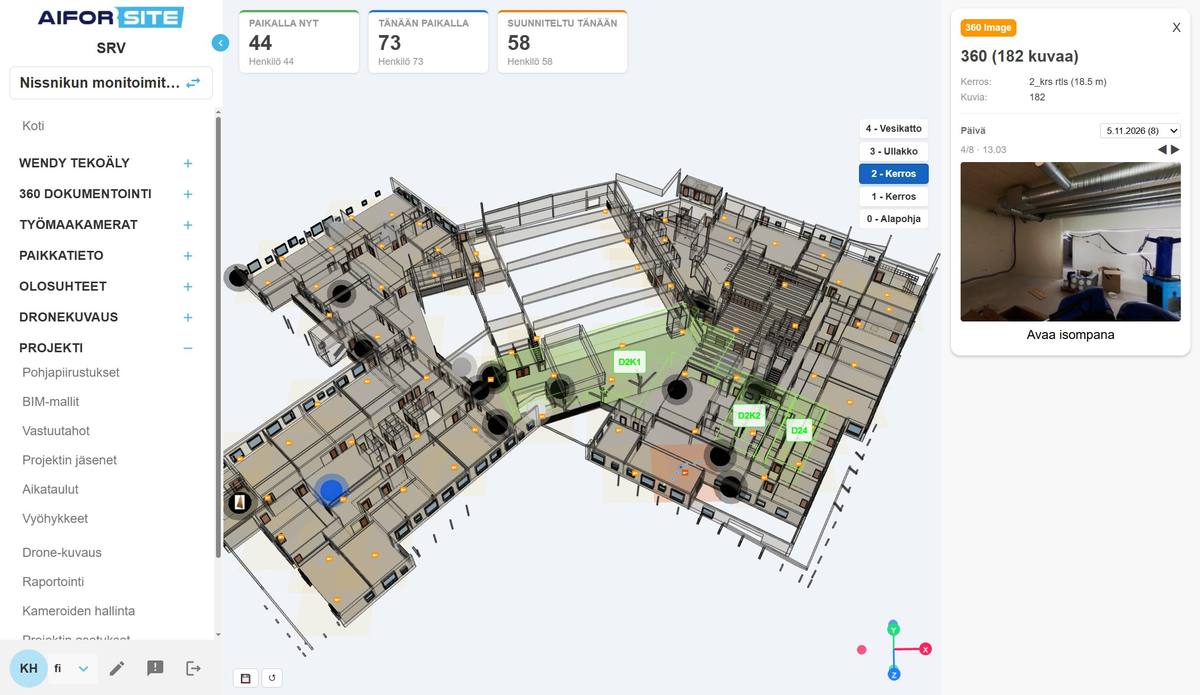
At SRV’s Nissniku multipurpose building, named Finland’s Construction Site of the Year 2026, site management sees from the Aiforsite Visual Site 3D view, which presents the site’s floor plans in three dimensions, how many people are on site now, how many have been on site today and how many were planned. When planned and actual headcount differ, the gap is visible the same day rather than in the weekly meeting. From the same view, 360° images of each floor and zone open by date, so progress can be compared directly with the previous capture.
In November 2026, Visual Site 3D will bring the site’s actual building information model into the view for all Aiforsite customers. Manning, 360° images and deviations will then be shown directly in the building model, by production area.
The location data quick view brings together a 30-day picture: the number of workers on site, the trend in working hours, how work is distributed across production areas, and a breakdown by contractor. A forecast shows expected manning for the coming days, helping site management prepare before a deviation occurs.
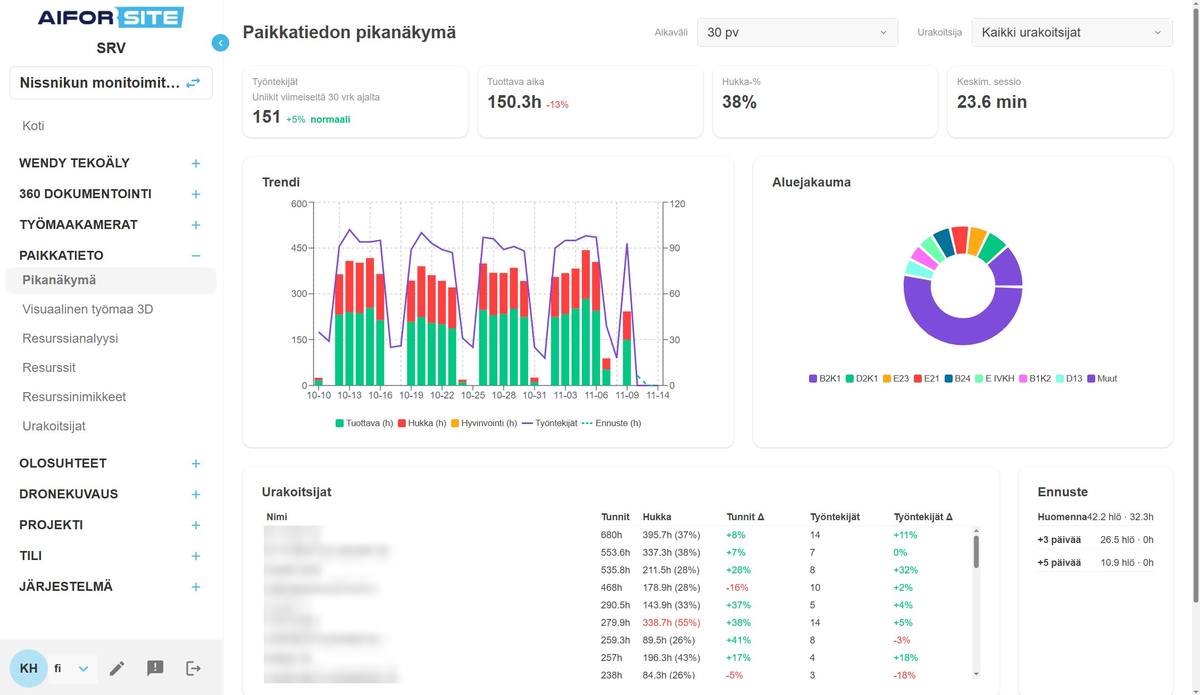
Location data shows presence, not on its own work performance or productivity. Observations are confirmed by site management.
Once the work packages are sold, management has only just begun
Traditional thinking in construction goes like this: once the work packages are sold to subcontractors, schedule, quality and costs are under control. But a contract transfers responsibility, not visibility. If nobody manages resource levels at task and production area level, problems only surface once they have already happened.
On critical tasks a delay does not stay in one place. When one production area is under-manned, the following work stages wait, subcontractors move elsewhere, and the problem accumulates across the whole project. Schedule, quality and cost risks then materialise at the same time.
Aiforsite has delivered location-based resource management for eight years. Management starts from a task-level plan:
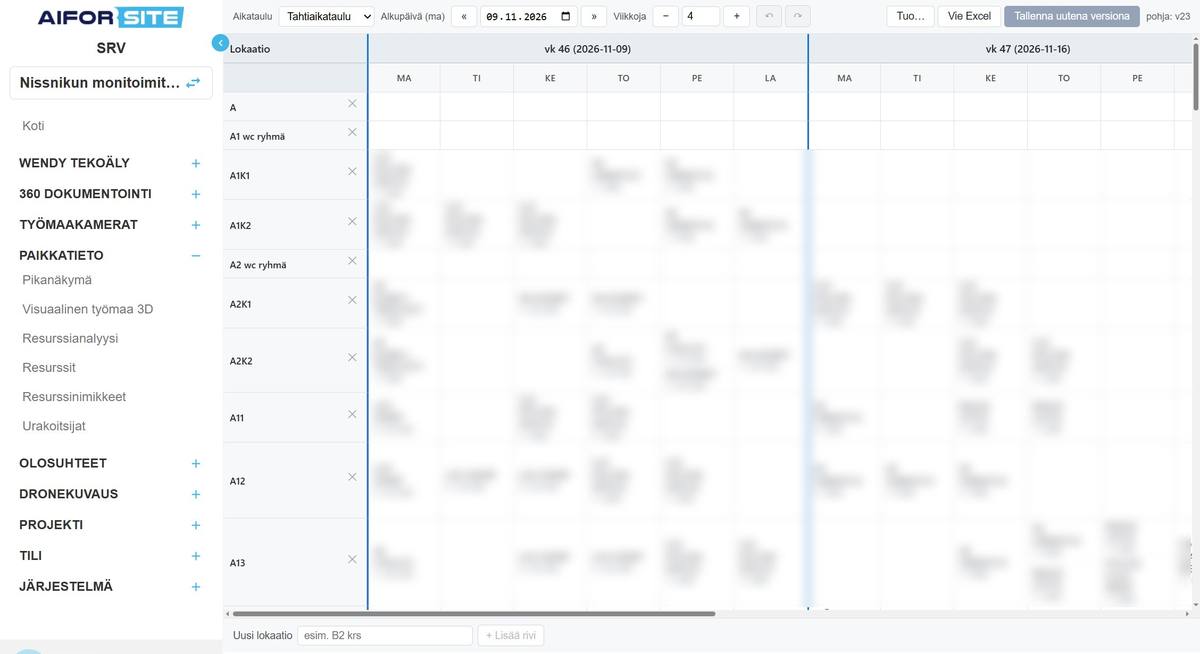
- Task-level production planning. In Aiforsite’s takt schedule, each production area and day is assigned a task and the resource it needs. Alternatively, Aiforsite reads the schedules the customer already uses.
- The plan is mirrored against location data. Site management sees daily whether the planned headcount is in the right production area at the right time.
- 360° data verifies progress. 360° images from the same area show whether work is progressing as planned.
- Wendy AI flags deviations. Site management confirms observations, prioritises work and agrees responsibilities before a delay multiplies.
Growth brings larger and more demanding projects to site, and in them predictability separates profitable projects from the rest. Selling the work packages does not yet make a site manageable; managing the resources does.
Start with a question every site manager recognises: where does your most expensive surprise happen in everyday site work? Book a 30-minute conversation and let’s look together at how it would show on your site.
Sources
- Confederation of Finnish Construction Industries RT: Data centres have driven construction growth (7 Oct 2026, in Finnish)
- Statistics Finland: Bankruptcies and business restructurings 2026, September (in Finnish)
- Statistics Finland: Use of information technology in enterprises 2025 (in Finnish)
- RICS: Productivity in Construction 2026
- McKinsey: Rewiring capital projects to boost construction productivity (2026)
- SRV Nissniku: real-time situational awareness at Finland’s Construction Site of the Year 2026