

Data centre construction is growing fast. AI, cloud services and growing data volumes are increasing the need for computing capacity, and the Nordic countries attract developers with their cool climate and clean energy. These projects share one feature: the schedule is tight, and every week of delay pushes back the commissioning of capacity.
For example, in September 2026 Google announced it would invest at least EUR 13 billion in AI infrastructure in Finland over two years. The plan includes three new data centres in Kajaani, Muhos and Vaala and an expansion of its data centre in Hamina, and it is Google’s largest single investment in Europe (Bloomberg).
This article explains what makes a data centre project especially demanding, where the schedule is usually put to the test and how up to date situational awareness and AI help keep critical work stages on schedule.
Why is a data centre project especially demanding?
A data centre is not an ordinary hall building. Its value lies in the building services: power, cooling, backup power and automation. This shows on site in many ways:
- Work stages depend on each other. Plant rooms must be complete before equipment installation, and installation and connections must be ready before testing can begin.
- One area can hold up the rest. Unfinished work in an electrical room or cooling area can put a milestone at risk, even when the rest of the project is on track. Overall completion is therefore not enough as a measure.
- Many contractors work in parallel. Building, electrical, HVAC, automation and equipment suppliers work in the same spaces at the same time.
- Commissioning is often phased. The first data hall can go live while the next is still being built, so the site and an operating facility exist side by side.
- Cleanliness is critical. Dust and contaminants can damage sensitive equipment, so condition control continues to the very end.
In these conditions, management focuses on the next work stage: are the preceding works and resources it needs ready on time? The earlier a deviation is detected, the more time there is for corrective action.
Situational awareness through the project stages
Frame and envelope. The early stage decides whether building services contractors can start on time. 360 images show the state of each space, and comparing the schedule with the images reveals which areas are behind. Condition monitoring ensures that concrete structures dry before coating and installation.
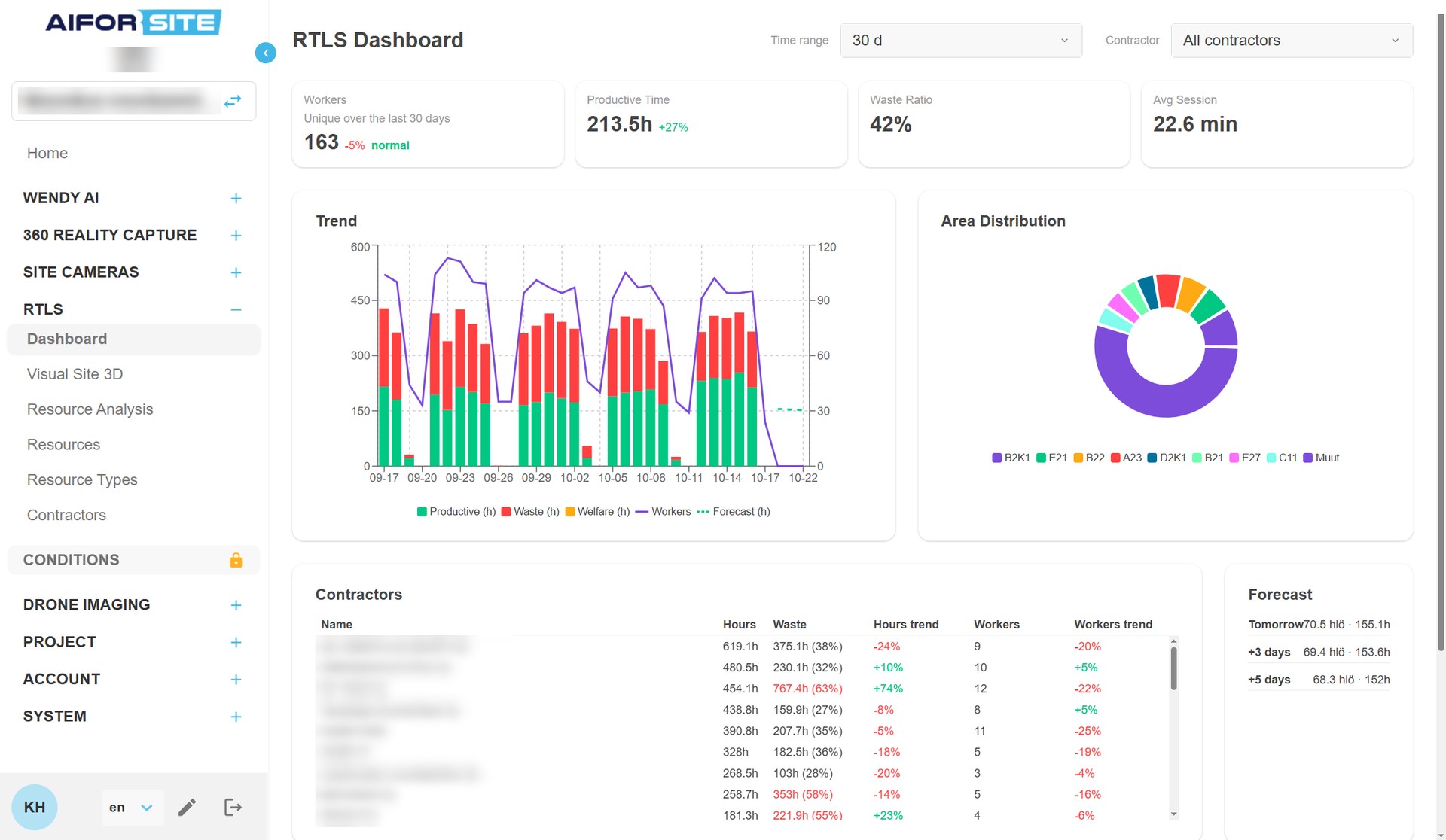
Building services and equipment installation. This stage has the most workers and contractors on site. Workforce Analytics shows whether the agreed crew is present and in the right area, and comparison with the plan reveals resource deviations daily. 360 images document cabling, piping and ductwork before they are covered.
Clean rooms and commissioning preparation. As the data halls are completed, dust and condition control become more important. The multisensor measures dust, temperature and humidity, and alarm thresholds tell you immediately if conditions go off target.
Before testing and commissioning. Images and schedule comparisons reveal visibly incomplete work before planned inspections and tests. Technical acceptance remains part of the project’s quality assurance, but there are fewer surprises.
A routine that keeps the schedule under control
Aiforsite’s data centre solution is built on a simple rhythm: plan, verify, analyse and act.
- Weekly: has the work progressed? The schedule is compared with 360 imagery. Wendy AI summarises progress deviations, and site management agrees priorities for upcoming works.
- Daily: are the resources on site? The schedule is compared with location data. Workflows runs agreed checks and flags staffing deviations for site management to review.
- Continuously: plan tomorrow better. Today’s actuals show how precise the daily plan was and help set tomorrow’s resource needs, work sequence and targets.
The same deviation may need a different solution
The observation guides the investigation, but site management verifies the cause before deciding on an action. If an area is behind schedule:
- Staffing is below plan: is the agreed crew available and in the right area? This is checked with the contractor.
- Staffing matches the plan: are materials, drawings or preceding works missing? Constraints are investigated before adding resources.
This way extra resources are not sent to an area where the problem lies elsewhere.
AI frees site management time for decisions
On a data centre site, more information is generated than anyone can go through by hand. Wendy AI brings the findings together: it compares the schedule with 360 images and planned crews with actual staffing, and tells you what to tackle first. Workflows routes agreed deviations directly to the people responsible, who agree actions with the contractor.
This way site management time is not spent gathering information and reporting but resolving deviations. Read more about how situational awareness lays the foundation for AI in the article Construction site situational awareness and AI.
Customer value comes from acting on the findings
Situational awareness only creates value when findings are acted on. That is why the baseline and measures should be agreed before deployment and tracked throughout the project. Good measures include:
- the time site management spends gathering information and reporting
- the time from detecting a deviation to taking action
- whether critical work stages are completed as planned
How to get started
- Identify the critical areas. Which spaces and work stages decide the milestones, for example electrical rooms and cooling areas?
- Agree the baseline and measures before deployment.
- Start regular 360 recording and workforce analytics so the schedule can be compared with the actual situation.
- Adopt the weekly and daily rhythm with Wendy AI and Workflows.
- Add condition and dust monitoring in the finishing stage and in clean rooms. Read more in the article Moisture safe construction in autumn.
Frequently asked questions
Why is a data centre schedule so sensitive?
Work stages depend on each other: plant rooms must be complete before equipment installation, and installation before testing. A delay in one critical area can hold up the contractors who follow.
How does Aiforsite help in a data centre project?
Aiforsite compares the schedule with 360 images and workforce location data, and Wendy AI highlights deviations before they delay the works that follow.
Does situational awareness replace technical acceptance?
No. Images and comparisons reveal incomplete work before inspections and tests, but technical acceptance remains part of quality assurance.
Can dust be monitored on a data centre site?
Yes. The multisensor measures dust, temperature, humidity, carbon dioxide and volatile organic compounds, which matters in clean rooms.
Summary
In a data centre project, the schedule is decided in the critical areas, not by overall completion. When the schedule is regularly compared with actual progress and resources, deviations are detected in time and the contractors who follow can start as planned.
Want to see how Aiforsite would work on your data centre project? Book a demo.